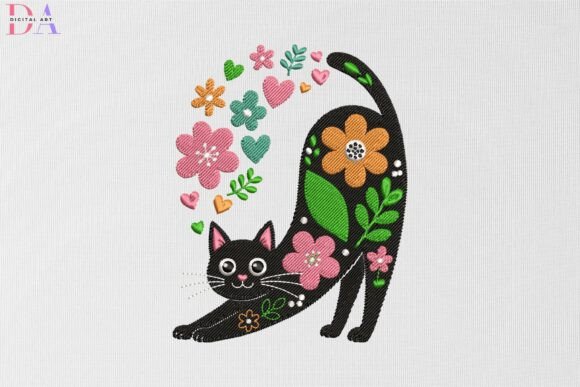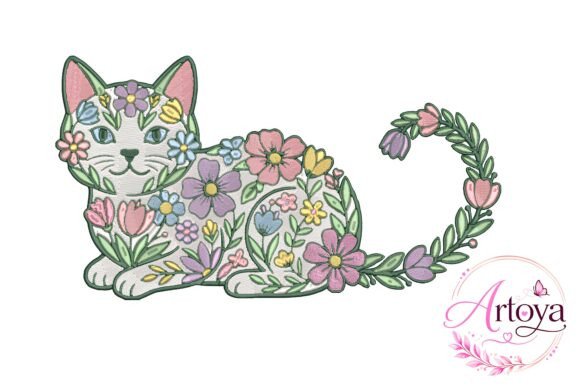
Floral Cat Embroidery Design
A Practical Review for Small Business Merch & Branded Patches
As an embroidery designer who’s developed hundreds of commercial designs for cafés, florists, pet brands, and handmade studios, I approached the Floral Cat Embroidery Design with a very specific question: Does this work as more than just a charming decoration — can it function as reliable, scalable brand identity across real-world small business applications?
First impression? It reads as whimsical yet refined — not overly cutesy, not stiffly formal. The pairing of “botanical” and “kitty” in the description signals a balance: soft floral beauty meets approachable feline personality. That duality is gold for businesses wanting warmth without sacrificing polish — think a neighborhood florist’s apron, a boutique bakery’s tote bag, or a pet wellness brand’s embroidered patch.
Where This Design Excels in Commercial Use
The Floral Cat Embroidery Design shines where small businesses need instant recognition and emotional resonance:
- Embroidered patches: Its layered but balanced composition holds up well at 2.5"–3.5" sizes — ideal for sew-on or iron-on branding on jackets, shop aprons, or staff uniforms.
- Cap embroidery: When scaled to fit standard front panels (typically 2"–2.25" wide), the cat’s silhouette and floral elements retain clarity without overcrowding — especially with thoughtful thread color selection.
- Tote bag design: As a centered chest accent or side panel motif, it adds artisanal charm without overwhelming canvas or cotton twill — a smart differentiator for local boutiques or craft markets.
- Apron embroidery: Positioned above the pocket or along the waistband, it reinforces a cohesive, handcrafted aesthetic — vital for bakeries, florists, or creative studios that lean into tactile authenticity.
- Custom apparel accents: Works beautifully as a subtle sleeve detail or back-collar mark on work shirts — elevating perceived product value without shouting.
- Product packaging accents: When stitched onto fabric tags, linen pouches, or reusable gift wraps, it quietly communicates care and intentionality — key for Etsy sellers and handmade brands.
Use With Intention: Where Caution Applies
This isn’t a one-size-fits-all file. As a working embroidery designer, I advise careful evaluation before production:
- Small patch sizes under 2": Fine floral details may blur or lose definition. Always test stitch-out at your target size — don’t rely solely on digital preview.
- Curved surfaces like cap fronts or rounded tote handles: Confirm the design’s outer shape accommodates gentle stretching without distortion. A tight circular outline works better than a wide horizontal layout here.
- Dark or textured fabric: High stitch density in floral elements can mute contrast on heavy denim or nubby linen. Run a black-and-white test first to assess legibility and balance.
- Frequent washing or high-friction use: If destined for staff aprons or café uniforms, verify thread colorfastness and stabilizer compatibility — botanical motifs often include delicate fill stitches that benefit from medium-weight cutaway stabilizer.
- Brand consistency: Compare the Floral Cat Embroidery Design beside your existing logo, typography, and other design assets. Does its whimsy align with your voice — or clash with a more minimalist or heritage-driven identity?
How It Strengthens Brand Identity & Customer Trust
In small business merch, every stitch communicates. The Floral Cat Embroidery Design doesn’t just look nice — it tells a story: attentive, gentle, rooted in nature and personality. That builds trust faster than generic clip art ever could.
For a local pet brand, it signals empathy and playfulness — qualities customers actively seek. For a flower shop, it bridges horticulture and heart. Even on a simple tote bag, it transforms functional item into branded keepsake — increasing customer retention and organic social sharing.
Crucially, it supports visual consistency across touchpoints: same motif on staff caps, packaging, and event merch creates subconscious reinforcement. And because it leans into handmade presentation without looking amateurish, it elevates perceived value — allowing small businesses to charge confidently for premium embroidered goods.
Essential Designer Notes Before You Stitch
Before committing to bulk production or client delivery, follow these practical steps:
- Test in black and white first — eliminates color bias and reveals true contrast and spacing issues.
- Check scalability — does the Floral Cat Embroidery Design hold integrity at your smallest intended size (e.g., 1.75" for cap fronts)?
- Review thread color contrast — especially against common uniform fabrics (navy, charcoal, olive). Avoid pastel-on-pastel combos unless intentional.
- Inspect spacing between floral elements and cat outline — tight gaps risk stitching errors or thread breaks on commercial machines.
- Confirm hoop size compatibility — ensure your embroidery machine’s standard hoop accommodates the design’s dimensions without re-hooping mid-stitch.
- Test on real fabric — always stitch a sample on your actual garment or patch material, not just stabilizer.
- Use proper stabilizer — medium-weight cutaway is safest for dense botanical fills; tear-away may shift on lightweight cottons.
- Create a printable mockup — present to clients with realistic fabric texture and scale — avoids misaligned expectations.
- Compare alongside other design assets — ensure visual harmony with logos, fonts, and secondary patterns.
- Verify commercial licensing — confirm the Floral Cat Embroidery Design permits use on products sold to end customers. Never assume — check the seller’s terms before launching small business merch.
When thoughtfully applied, the Floral Cat Embroidery Design isn’t just another machine embroidery design — it’s a versatile, emotionally intelligent tool for building memorable, professional, and distinctly human brand experiences. Whether you’re stitching for a single Etsy listing or outfitting an entire team, let this botanical kitty earn its place — not as filler, but as functional identity.